
Engineers sourcing switching components often encounter two terms used almost interchangeably: bistable relay and magnetic relay. While the confusion is understandable, these terms describe overlapping but distinct concepts. A magnetic latching relay is technically a type of bistable relay, but not every bistable device relies on the same magnetic mechanism. This article breaks down the technical distinctions, operational logic, and practical selection criteria so you can specify the right component for your application.
A latching relay is an electromechanical switch that maintains its contact position after the coil signal is removed. Unlike a standard relay that requires continuous current to stay energized, a magnetic latching relay uses a permanent magnet to hold the armature in place mechanically. This is why it is also referred to as a magnetic holding relay or permanent magnet relay.
The defining trait is simple: apply a short current pulse to switch state, then remove power entirely. The relay stays in that state until an opposite pulse is applied. This behavior is where the term pulse relay originates.
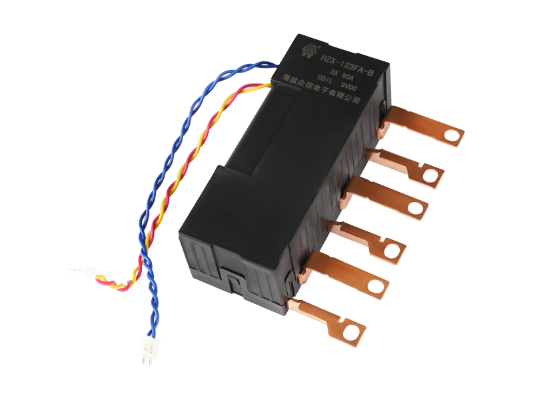
The word bistable is a broader engineering term describing any system with two stable states, neither of which requires continuous energy input to maintain. In relay terminology, a bistable electromagnetic relay is any relay that stays in either the open or closed position without ongoing power.
Magnetic latching is the most common method used to achieve bistability in relays, but it is not the only mechanism. Mechanical latching relays, for example, use physical detents or ratchet mechanisms rather than magnetic force to hold the contact position.
| Mechanism | Holding Method | Reset Method |
|---|---|---|
| Magnetic latching | Permanent magnet | Reverse coil pulse |
| Mechanical latching | Physical detent or catch | Secondary actuator or lever |
| Standard relay | Continuous coil current | Power removal |
To clarify the relationship, think of it this way: all magnetic latching relays are bistable, but not all bistable relays are magnetic. The table below outlines functional differences relevant to design engineers.
| Feature | Magnetic Latching Relay | Generic Bistable Relay |
|---|---|---|
| Holding power | None required | Depends on mechanism |
| State memory during outage | Yes | Yes, if latching type |
| Coil pulse duration | Short (ms range) | Varies by design |
| Common applications | Metering, PCB, low power systems | Industrial control, automation |
| Wear mechanism | Magnetic degradation over cycles | Mechanical wear on latch parts |
The internal structure of a magnetic latching relay typically includes a coil, an armature, and a permanent magnet positioned to interact with the magnetic field generated during switching. When current flows through the coil in one direction, the resulting magnetic field either reinforces or opposes the permanent magnet's field, moving the armature to a new position. Once the armature reaches that position, the permanent magnet alone holds it there.
Key insight: Because holding current is eliminated entirely, magnetic latching relays are frequently chosen for battery-powered or energy-metering equipment where standby consumption directly affects operating costs.
Two common configurations exist for controlling a magnetic latching relay:
The diagram below illustrates the basic pulse-and-hold cycle common to magnetic latching relay operation.
The main motivation for selecting a magnetic latching relay over a conventional one is energy efficiency, but the benefits extend further into reliability and system design.
| Relay Type | Holding Current | Typical Standby Draw |
|---|---|---|
| Standard electromagnetic relay | Continuous | Tens of milliamps |
| Magnetic latching relay | None | Zero |
In large-scale deployments such as smart metering networks with thousands of installed units, eliminating continuous holding current translates into measurable reductions in total system power draw, particularly in battery-backed or solar-powered installations.
Magnetic latching relays, including DC magnetic latching relay and AC magnetic latching relay variants, appear across a wide range of control systems.
| Application Area | Why Latching Is Preferred |
|---|---|
| Smart electricity meters | Zero standby power extends battery life and reduces grid load |
| Building automation panels | Contact state persists through brief power interruptions |
| PCB-mounted control modules | Compact footprint suits space-constrained boards |
| Industrial load switching | Frequent cycling without excessive coil heat buildup |
A PCB latching relay is designed for direct surface or through-hole mounting, prioritizing a small footprint alongside latching functionality. A power latching relay, by contrast, is built for higher current handling in applications such as motor control or heavier load switching, often trading footprint size for increased contact rating.
When evaluating a magnetic latching relay manufacturer, technical buyers typically assess several factors beyond price:
Reliable magnetic latching relays manufacturers typically provide detailed datasheets covering pulse timing tolerances, since incorrect pulse duration is one of the most common causes of switching failure in field deployments.
A magnetic latching relay is a switching device that uses a permanent magnet to hold its contact position after a brief control pulse, requiring no continuous power to maintain state.
A short current pulse moves the armature to a new position, where a permanent magnet then holds it in place until an opposite pulse is applied to reverse the state.
It eliminates continuous holding current, reduces coil heat, and retains its switching state through power interruptions, making it well suited for energy-sensitive or remote applications.
Yes. Because no current is needed to maintain either state, total energy consumption is significantly lower than a standard relay that must stay energized to remain closed.
Yes. Their zero standby current and ability to retain switch position during outages make them a common choice in smart metering and other low-power monitoring systems.

Copyright © 2015-2021, Zhejiang Zhongxin New Energy Technology Co., Ltd. All rights reserved Technical Support:Smart cloud Electromagnetic Relay Manufacturers China Relays Factory


 English
