
Electromagnetic relays enhance electrical circuit efficiency primarily by enabling a low-power control signal to safely and reliably switch a high-power load, achieving near-zero power loss in the control side and minimal contact resistance (typically in the milliohm range, e.g., 50–100 mΩ). This separation reduces wasted energy compared to mechanical switches or uncontrolled semiconductor pass elements. For example, a 5V, 20mA relay coil can control a 250V, 10A AC load, resulting in a control power of only 0.1W to manage 2500W – an efficiency gain of over 99.99% in terms of signal-to-load power ratio.
In many automation and power distribution systems, using relays instead of continuous-duty solid-state switches can lower heat generation. When a relay is energized and latched, the coil holds the armature, but once closed, no further control power is needed to maintain the load current path. More importantly, the contact resistance when closed is extremely low.
Data comparison: A typical triac (solid-state relay) may have an on-state voltage drop of 1.0–1.5V. At 10A, this dissipates 10–15W. An electromagnetic relay with 50mΩ contact resistance at the same current dissipates only 0.5W. Over continuous operation, this reduces heat and improves overall system reliability.
While electromagnetic relays offer conduction efficiency, their switching speed (typically 5–20 ms operation time) is slower than solid-state relays (microseconds). However, for industrial control and appliance circuits, this speed is more than adequate. The efficiency advantage lies in steady-state conduction, not in high-frequency switching.
Modern sensitive relays consume as low as 50–200 mW for DC coils, significantly enhancing system-level energy efficiency. For battery-powered or IoT devices, latching relays (bistable relays) consume zero power in the steady ON or OFF state, only requiring a pulse (10–50 ms) to change state. This makes them ideal for remote sensing and energy-harvesting applications.
A smart home controller uses a 3.3V, 40mA GPIO to drive a relay coil (coil power 0.132W). The relay switches a 2200W water heater. The controller spends 0.132W to control 2200W, meaning the control overhead is only 0.006% of the load power. This allows the system to remain efficient while electrically isolating the low-voltage microcontroller from mains voltage.
To extract the efficiency from an electromagnetic relay in any circuit, follow these design and selection rules:
The table below summarizes efficiency-related parameters for common load-switching components at 10A, 250V AC (resistive load).
| Component | On-state resistance / drop | Power loss at 10A | Control power required | Relative efficiency (load power = 2500W) |
|---|---|---|---|---|
| Electromagnetic Relay (good contacts) | 50 mΩ | 5W | 0.1–0.5W | 99.8% |
| Solid State Relay (triac based) | 1.2V drop | 12W | ~0.02W (LED drive) | 99.52% (lower due to higher conduction loss) |
| MOSFET (ideal, but needs isolation) | 10 mΩ | 1W | Gate drive + isolation | 99.96% but lacks galvanic isolation |
The electromagnetic relay provides a balanced solution: complete galvanic isolation (isolates control from load) plus very low conduction loss, making it to SSRs for many AC mains applications where heat sinking is undesirable.
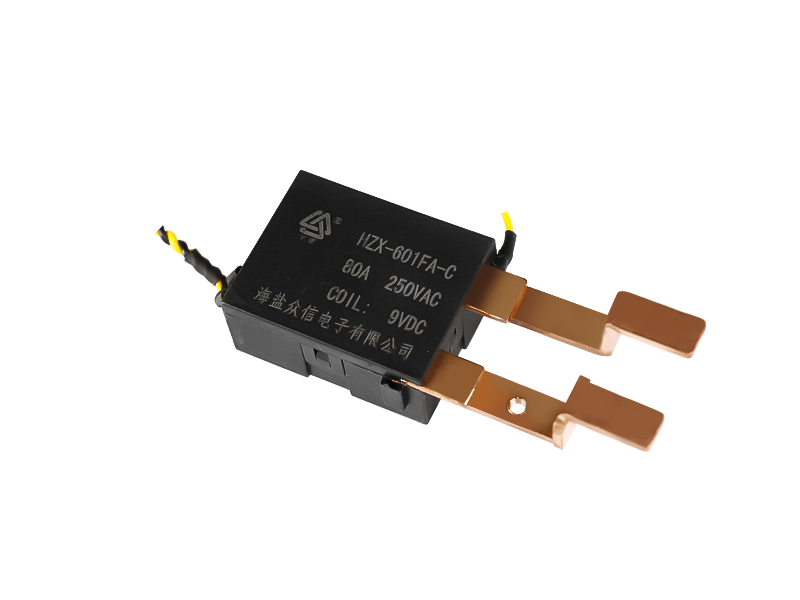
Over millions of operations, contact wear can increase resistance and reduce efficiency. For inductive loads (motors, solenoids), the arcing during break can cause carbon buildup. The solution: specify relays with silver-tin-oxide (AgSnO₂) contacts instead of silver-cadmium-oxide (AgCdO) for better arc resistance. Data shows that under 10A inductive load at 250V AC, AgSnO₂ contacts maintain below 100 mΩ resistance for over 100,000 cycles, while cheaper contacts may rise to 500 mΩ within 50,000 cycles, causing 5× higher conduction loss.
For circuits requiring efficiency over product lifetime, choose sealed or gas-filled relays to prevent oxidation. This ensures contact resistance remains stable, directly preserving energy savings.
Electromagnetic relays enhance circuit efficiency not by theoretical perfection but by offering an unmatched combination of low conduction loss (mΩ-level resistance), complete galvanic isolation, and minimal control power requirement. In real-world systems ranging from HVAC controls to industrial automation, they consistently outperform solid-state alternatives in thermal efficiency and cost. By selecting the correct coil voltage, using latching types where applicable, and specifying quality contact materials, designers can achieve greater than 99.7% power transfer efficiency for the switched load while maintaining safe low-voltage control interfaces.

Copyright © 2015-2021, Zhejiang Zhongxin New Energy Technology Co., Ltd. All rights reserved Technical Support:Smart cloud Electromagnetic Relay Manufacturers China Relays Factory


 English
