
An electromagnetic relay operates as an electrically controlled switch that uses a low-power electromagnetic coil to generate a magnetic field, attracting an armature and mechanically opening or closing contacts, thereby switching a high-power load circuit. This provides galvanic isolation and enables low-voltage logic to safely control high-voltage/high-current systems. Typical small-signal relays handle control currents as low as 20 mA while switching loads up to 10 A/250 V AC, proving the fundamental “small controls large” capability.
Electromagnetic relays rely on Ampere’s law and magnetic attraction. When a current passes through the relay coil, it produces a magnetic flux that travels through a ferromagnetic core, yoke, and armature. The resulting magnetic force overcomes the spring tension, pulling the armature toward the core. The moving armature transfers motion to the contact spring, changing the state of the contacts (normally open closes, normally closed opens). Once coil current is removed, the spring returns the armature to its rest position.
Key practical data: Typical electromagnetic relays exhibit pickup voltage (must-operate) at 70–75% of nominal coil voltage. For a 12 V DC relay, the armature will reliably pull-in at ≈8.4 V DC, while dropout (release) voltage is about 10% of nominal (≈1.2 V DC) ensuring hysteresis margin. Coil power typically ranges from 200 mW to 1.2 W depending on relay size.
Every electromagnetic relay consists of several distinct parts that cooperate to achieve reliable switching. Understanding each part aids in design and troubleshooting.
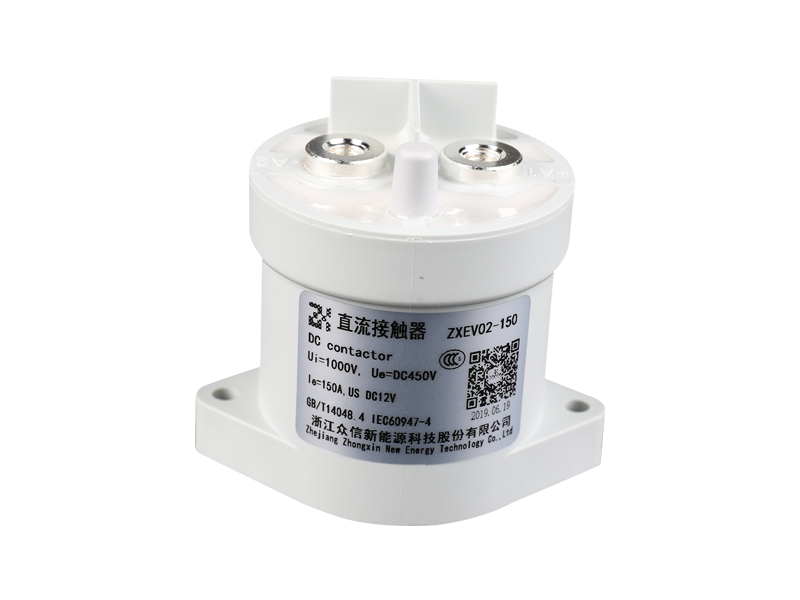
Structural example: In a high-capacity DC relay for energy storage, double-break contacts and magnetic blowout arcs extinguish efficiently, extending electrical life beyond 100,000 cycles at 450 VDC/50 A.
Electromagnetic relay switching follows a deterministic sequence: Coil energization → flux build-up → armature pick-up → contact transfer → stable ON state. When de-energized, the opposite cycle begins. Actual timing is critical for protection and sequencing applications.
For high-voltage DC applications (EV charging, photovoltaic inverters), sealed polarized relays use permanent magnets to achieve faster operation (<5 ms) and reduced contact erosion. Designers must account for inrush current which can be 5–10× steady-state value; relay contacts require adequate derating.
Selecting an electromagnetic relay demands evaluation of coil ratings, contact ratings, and environmental limits. The table below summarizes typical values for general-purpose and power relays, which provides a practical reference for engineers.
| Parameter | Typical Range / Example | Influence on Selection |
|---|---|---|
| Coil nominal voltage | 5 V, 12 V, 24 V DC, 110 V AC | Control signal compatibility |
| Coil resistance | 60 Ω (5 V) to 1.2 kΩ (24 V) | Determines coil current draw & driver requirements |
| Maximum switching voltage | 250 V AC / 30 V DC (general) – up to 1000 VDC (DC power relays) | Arc suppression & insulation rating |
| Rated contact current | 2 A – 40 A (power relays) | Load type: resistive vs inductive derating (typical factor 0.3 for inductive loads) |
| Electrical life (resistive load) | 100,000 – 1,000,000 operations | Application longevity requirement |
| Mechanical life | 10 million – 50 million cycles | High-frequency switching suitability |
Design note: For inductive DC loads (motors, solenoids), use flyback diodes across the coil and appropriate arc suppression (RC snubber across contacts) to extend relay life by up to 5× compared to unprotected switching.
Implementing electromagnetic relays in real-world systems requires attention to coil drive margins, contact protection, and thermal management. Below are actionable recommendations supported by common engineering practice.
Data example: In automotive applications, relays operating at 85°C ambient experience 20% reduced coil force; selecting a relay with a nominal coil voltage of 12 V and 8 V pull-in guarantees robust actuation even under voltage dips down to 9 V (ISO 16750-2).
Choosing the right electromagnetic relay topology improves system efficiency and safety. Common types are based on contact form, switching capacity, and environmental robustness.
Selection tip: Always verify breaking capacity for DC loads because DC arcs are harder to extinguish than AC. A rule of thumb: the DC breaking voltage rating of a relay is typically 30–50% of its AC rating. For high-voltage DC applications, prioritize relays specifically rated for DC switching with magnetic blowout technology.
The following diagram illustrates the functional sequence of a typical electromagnetic relay, from input command to load switching.
Real-time parameters: The actual operate time comprises coil inductance delay (L/R time constant) plus mechanical inertia. For a 12 V, 360 Ω relay (L ≈ 0.4 H), electrical time constant τ ≈ 1.1 ms, and overall operate time ≈ 8 ms at nominal voltage. Designers can accelerate response by increasing voltage momentarily (e.g., 200% rated voltage for 10 ms).
Q1: What is the difference between pick-up voltage and dropout voltage?
Pick-up voltage (must-operate) is the coil voltage that ensures all contacts reliably change state. Dropout voltage is the coil voltage at which the relay is guaranteed to release. The hysteresis ensures stable operation and avoids chattering. Standard ratio: pick-up ≈ 70 % Vnom, dropout ≈ 10 % Vnom.
Q2: How does ambient temperature affect electromagnetic relay performance?
Temperature rise increases coil resistance, reducing available ampere-turns. For every +20°C above 20°C, pick-up voltage increases by ~8%. The permissible coil temperature (insulation class) limits continuous operation. Derating coil voltage by 10% at high ambient is recommended for long life.
Q3: Can I use an AC-rated relay for DC loads?
It is not recommended without careful verification. AC relays rely on zero-crossing to extinguish arcs; DC arcs are continuous and cause rapid contact erosion. Unless the relay datasheet explicitly provides DC switching ratings, select a dedicated DC relay or use a hybrid approach with external arc suppression.
Q4: What are common failure modes of electromagnetic relays?
Contact welding (high inrush), coil burnout (overvoltage or prolonged overheating), contact corrosion (inadequate sealing for humidity), and mechanical fatigue after millions of cycles. Proper derating and coil suppression drastically reduce these failures.
Q5: How to choose between a solid-state relay and an electromagnetic relay?
Electromagnetic relays offer negligible leakage current when off (<1 µA), galvanic isolation, low on-resistance (mΩ), and withstand surge voltages well. Use EM relays for high-efficiency, low heat generation, and mixed loads. SSR suits high-frequency switching and silent operation but has higher off-state leakage and voltage drop.
Technical summary: Electromagnetic relays provide robust, economical galvanic isolation with proven reliability. By understanding fundamental parameters – coil pick-up/dropout, contact material, and load-specific derating – engineers can achieve decades of maintenance-free operation in applications ranging from automotive to renewable energy systems.


Copyright © 2015-2021, Zhejiang Zhongxin New Energy Technology Co., Ltd. All rights reserved Technical Support:Smart cloud Electromagnetic Relay Manufacturers China Relays Factory


 English
